
TEENS INTERNAL GOVERNANCE: MISSING LINK IN MODERN PARENTING
The Self-Governing Teen: How Internal Structure Transforms Families
TEENS PARENTING
BY: IZZY OGUNMEKAN
2/14/20262 min read

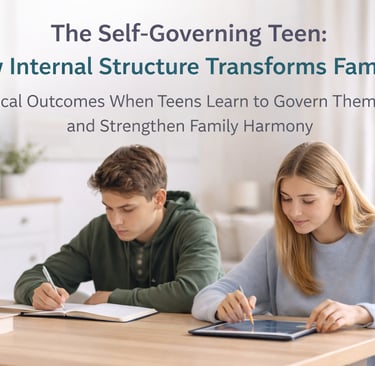
When teens develop the ability to govern themselves, the entire family ecosystem shifts.
Not suddenly. Not magically. But predictably and measurably.
The Teen Who Can Self-Govern
A self-governing teen understands attention, identity, and self-leadership.
They can:
Focus on important tasks without constant prompting
Resist digital distractions intentionally
Make decisions aligned with long-term growth and values
Navigate peer pressure and trends with discernment
This is not about rebellion or independence from parents.
It is about internal structure that supports external guidance.
How Family Dynamics Improve
When internal governance exists, parenting strategies multiply in effectiveness:
Conflict Decreases: Teens anticipate expectations and manage impulses before friction arises.
Communication Improves: Teens can articulate choices, reasoning, and feelings clearly.
Trust Deepens: Parents observe consistent, responsible behavior without micromanaging.
Digital Boundaries Stick: Teens regulate their own exposure to screens and online influence
The household moves from reactive management to proactive growth.
Real-World Scenarios
Scenario 1: A teen completing homework on time without repeated reminders. Parents notice consistency and can redirect energy toward mentorship and guidance.
Scenario 2: A teen encountering a social media trend and evaluating it critically instead of following blindly. Parental rules reinforce, but internal discernment leads.
Scenario 3: A teen facing peer pressure in school and choosing a path aligned with family and personal values. Parents observe confidence and alignment without daily oversight.
These examples illustrate the compounding effect of internal governance.
The Architectural Thread
Think of the family like a building:
Foundation: Teen internal governance (attention, digital discernment, self-leadership)
Pillars: Parental strategy, faith instruction, life skills
Load-bearing structure: Communication, responsibility, conflict resolution
Upper floors: Academic achievement, social relationships, long-term growth
When the foundation is solid, every structural element above it performs more effectively.
Moving From Theory to Practice
Parents and leaders can support internal governance by:
Modeling focused attention and intentional decision-making
Guiding teens in understanding digital influence
Providing choices that require accountability
Celebrating small wins in self-leadership and responsibility
Encouraging reflection and self-assessment rather than only correcting behavior
Applied consistently, the results compound.
Conclusion: The Family as Ecosystem
Internal governance in teens transforms the family from a reactive system to an integrated ecosystem.
Parents focus on strategy, teens focus on structure, and the family experiences harmony, trust, and sustainable growth.
Equipping teens to govern themselves is not an optional enhancement—it is the missing layer that allows all other parenting and leadership strategies to thrive.